
Feng Shui Introduction
Master Chuan’s Philosophy
Master Chuan believes in using the external and internal energies of our daily environment to obtain an optimal harmony in our work and living space. With many years of experience and using various schools of thought in Feng Shui (Fei Xing, San Yuan, San He, Wu Chang Pai, etc.) Master Chuan aims at solving common problems in areas like Wealth, Health, Relationship and Work of a person by applying the knowledge of Feng Shui.
Feng Shui has often been seen as a traditional discipline that requires major knocking and changing of the living and working space in order to achieve desired result. However, Master Chuan strongly believes in using recommendations that will fit into the design concept and budget of the families’ or offices’ modern and contemporary theme. Master Chuan will match the usage of the space with the classical Feng Shui knowledge and recommend the best way to utilise the space for any specific purpose.
Besides normal space allocation, Master Chuan would also analyse the birth date and time (Ba Zi [八字]) information of the household occupants or the top management of a company to allocate better usage of the space in order to further enhance the energies of each individuals.

What is Feng Shui?
Feng Shui or Geomancy is a traditional classical knowledge that has been practised by the Chinese for many centuries. Feng Shui used to be a very well guarded knowledge and were only passed from generations to generations or only to very few trusted persons. In antiquity, such knowledge were only passed on by mouth and no written records were supposed to be done. However, time has changed and currently, there are many popular Feng Shui books and theories out there which are easily available to the general public. Feng Shui is an art that involves more than these common books that one can get hold of easily in the public. A detailed Feng Shui analysis of the house involves many layers of considerations like understanding the favourable elements of the occupants, understanding the incoming and outgoing “Qi” of the house, knowing the actual distribution of the “Qi” within the house, identifying the negative and positive energies of each section of the house in terms of the “Period” distribution, identifying the energies of each section of the house in terms of the yearly distribution, knowing the remedies for internal and external problematic sectors, knowing the correct usage of the sector for enhancement of wealth, health, relationship and work, etc. There are many more considerations that a master has to analyse before he can give any Feng Shui recommendations to a client.
The basic objective of Feng Shui is to create harmony and balance of energies of the environment (internal and external) to achieve general well being and “luck” of the occupants. Such well being can be for wealth, health, relationships, work, children, knowledge, power, etc. Feng Shui is a form of metaphysical studies that has nothing to do with any specific religious practices. There are many people from different countries and different ethnic groups or religions who have used Feng Shui successfully without having to do any specific religious ceremony. Feng Shui involves the understanding of the environmental energies and how we can harness these internal and external environmental energies to allow the occupants to enjoy these harmonious energies.
There are five main factors that commonly mentioned in the Chinese culture that result in the “good life” of a person,?“一命二运三风水,四积德五读书”.
Life (命) refers to your birth date and time information (Ba Zi [八字]) and this would determine to a certain extent what type of life you will be leading and how good your life will be. However, by knowing about your life and making correct decisions at certain point, one can avoid pitfalls and optimise their returns in life correctly.
Fate (运) refers to the luck cycle that direct ones’ life. Generally, it is believed that this luck cycle goes up and down depending on the type of life you are supposed to have based on your birth date and time. It is also commonly believed that Feng Shui enhancement can also help to steer these luck to a better or even a good cycle.
Feng Shui- Man made objects and the flow of "Qi" (Energy) |
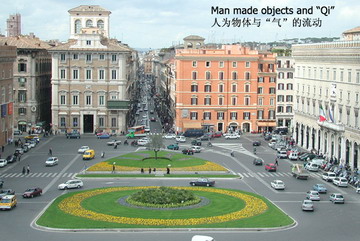
Feng Shui (风水) refers to the harnessing of the environmental energies to create a balance between the five elements and “Qi” of an environment. “Qi” (气) refers to the cosmic energies that emerges from all matter, living or non living, natural or man made. In classical Feng Shui, it is also believed that these energies have certain behavioural characteristics at any given time, space, and conditions. It is with the knowledge to decipher such energies that allows the Feng Shui Master to know how to optimise the harmony of the energies.
Accumulating merits (积德) refers to the fact that one must continuously do good deeds for others and oneself with the correct frame of mind (unconditional giving) such that these good energies that one gives will some how return to oneself in some ways. This is also what most believed that it can help to change one’s life totally for the better.
Learning (读书) is referring to proper education (beyond the normal academic sense) in various discipline where one can improve one’s knowledge in order to be a better person. Ancient Chinese believed that knowledge and wisdom is a form of power and a knowledgeable person is often associated to becoming a high official who will normally hold high power and good wealth. Thus prosperity is also closely linked to knowledge and wisdom.
Feng Shui is only part of the factors that help to enhance and change the life of a person. Thus besides having a Feng Shui audit done for one’s home or commercial premise, it is also essential for one to look into the other aspects of a person’s life to see how we can improve our overall well being.
Master Chuan's Feng Shui services
- Feng Shui Audit for HDB / Private or commercial property
- Feng Shui activation of the wealth corner of the house (财位)
- Using Feng Shui to improve health of the whole family or a particular person
- Using Feng Shui to improve sleep quality of children
- Using Feng Shui to activate the study corner of children (文昌位)
- Using Feng Shui to plan the space usage in a house or office
- Creating harmony within the home and office
- Feng Shui Courses
- Feng Shui talks for corporate and other organisations
- Short Feng Shui courses for small events
>>Testimonials of clients who consulted Master Chuan<<
Consultation Charges:
| HDB Flats | |
| 3 Rooms | SGD $688 |
| 4 Rooms | SGD $788 |
| 5 Rooms | SGD $888 |
| Executives | SGD $988 |
| HUDC | SGD $988 |
| Condo | |
| All sizes | SGD $988 and above |
| Private Landed Property | SGD $1588 and above |
| Commercial Property (Depending on size of property and involvement of the project. Please call to enquire.) | SGD $788 and above |
Please contact Master Chuan for other charges details*
Tel: +(65) 981 88 981
* Private consultations are available from
Mon-Fri 11am to 10pm,
Sat -Sun 9am to 8pm.
Strictly by appointments only.
 |
Checkout Master Chuan's new Palmistry ebook "The True Secrets of Palmistry" NOW! |
| singapore, feng shui, flying star, chinese, master, palmistry course, hand lines, environment, yin yang, five elements, divination, wealth, health, relationships, children, child, improve life, improve studies, love, studies, palmistry, hands, palm reading, lines, palm, fate, relationship, future telling, heart line, love line, wisdom, hand, line of life, New Age, forecasts, consultant, chiromancy, cheiromancy, cheirology, chirology, child psychology, children psychology, children development, earth, metal, water, wood, fire, chuan, fengshui, fengshui course, feng shui course, fortune telling, accurate, good palmist, head line, heart line, fate line, health line, predict health, prediction, free, change life, healing, curing, chinese medicine, free palmistry, free palm reading, free ebook, learn palmistry, learn free palmistry, learn free palm reading, learn palm reading, master Chuan, chuanonline, chuan, Auspicious date, good wedding date, auspicious wedding date, select wedding date, auspicious day, auspicious, wedding date selection, auspicious date for ROM, four pillar analysis, four pillar, Ba zi, bazi, palmistry lesson, palmistry basics, palm reading lesson, palm reading course, palmistry Singapore, palm reading Singapore, palm reader Singapore, palmist Singapore, fengshui master Singapore, feng shui master Singapore, recommended feng shui master, recommended fengshui master, singapore, feng shui, flying star, chinese, master, palmistry course, hand lines, environment, yin yang, five elements, divination, wealth, health, relationships, children, child, improve life, improve studies, love, studies, palmistry, hands, palm reading, lines, palm, fate, relationship, future telling, heart line, love line, wisdom, hand, line of life, New Age, forecasts, consultant, chiromancy, cheiromancy, cheirology, chirology, child psychology, children psychology, children development, earth, metal, water, wood, fire, chuan, fengshui, fengshui course, feng shui course, fortune telling, accurate, good palmist, head line, heart line, fate line, health line, predict health, prediction, free, change life, healing, curing, chinese medicine, free palmistry, free palm reading, free ebook, learn palmistry, learn free palmistry, learn free palm reading, learn palm reading, master Chuan, chuanonline, chuan, Auspicious date, good wedding date, auspicious wedding date, select wedding date, auspicious day, auspicious, wedding date selection, auspicious date for ROM, four pillar analysis, four pillar, Ba zi, bazi, palmistry lesson, palmistry basics, palm reading lesson, palm reading course, palmistry Singapore, palm reading Singapore, palm reader Singapore, palmist Singapore, fengshui master Singapore, feng shui master Singapore, recommended feng shui master, recommended fengshui master, singapore, feng shui, Currently Yangshao and Hongshan cultures provide the earliest evidence for Feng Shui. apparently Feng Shui relied on astronomy to find correlations between humans and the universe. In 4000 BCE the doors of Banpo dwellings were aligned to the asterism Yingshi just after the winter solstice -- this sited the homes for solar gain. During the Zhou era, Yingshi was known as Ding and used to indicate the appropriate time to build a capital city, Cosmography that bears a striking resemblance to modern Feng Shui devices and formulas was found on a jade unearthed at Hanshan and dated around 3000 BCE. The design is linked by archaeologist Li Xueqin to the liuren astrolabe, zhinan zhen, and Luopan. Beginning with palatial structures followed rules of Feng Shui for their design and layout. These rules were codified during the Zhou era in the Kaogong ji (traditional Chinese: 考工記; simplified Chinese: 考工记; "Manual of Crafts"). Rules for builders were codified in the carpenter's manual Lu ban jing (simplified Chinese: 鲁班经; "Lu ban's manuscript"). Graves and tombs also followed rules of Feng Shui, from Puyang to Mawangdui and beyond. A feng shui spiral at station.The history of feng shui covers 3,500+ years before the invention of the magnetic compass. Its origins are in astronomy.[13] Some current techniques can be traced to Neolithic China, while others were added later (most notably the Han dynasty, the Tang, the Song, and the Ming).[15] The astronomical history of Feng Shui is evident in the development of instruments and techniques. According to the Zhouli the original Feng Shui instrument may have been a gnomon. Chinese used circumpolar stars to determine the north-south axis of settlements. This technique explains why Shang palaces at Xiaotun lie 10° east of due north. In some cases, as Paul Wheatley observed,[16] they bisected the angle between the directions of the rising and setting sun to find north. The oldest examples of instruments used for feng shui are liuren astrolabes. from tombs that date between The magnetic compass was invented for Feng Shui and has been in use since its invention. Traditional Feng Shui instrumentation consists of the Luopan or the earlier compass differences. A Feng Shui ruler (a later invention) may also be employed. Foundation theories The goal of feng shui as practiced today is to situate the human built environment on spots with good qi. The "perfect spot" is a location and an axis in time. Some areas are not suitable for human settlement and should be left in their natural state. In New Age interpretations of Feng Shui, "qi" typically is " (usually interpreted as willpower and initiative). A more traditional explanation of qi as it relates to Feng Shui would consider a holistic understanding of local microclimates, the orientation of the structure, its age, and its he surrounding environment from the slope of the land to the vegetation and soil quality. One use for a Luopan is to detect the at feng shui assesses the quality of the local environment and the effects of space weather -- that is, feng shui is qi, or qi divination.[20] Beliefs from the Axial Age, feng shui among them, hold that the heavens influence life on Earth. This seems preposterous to many people, yet space weather exists and can have profound effects on tec grids, pipelines, communication and navigation systems, surveys), and the internal orienting .[23][24][25] There is some evidence that suicide rates in Kirovsk, Russia, fluctuate along with the geomagnetic field. The so-called "elements" of feng shui (water, wood, fire, earth/soil, metal) are made of yin and yang in precise amounts (Greater wood has less yin than lesser Earth is a buffer, or an equilibrium achieved when the polarities cancel each other. This explains why feng shui is said to be about balance. Bagua (eight symbols) Two diagrams known as bagua (or pa kua) loom large in feng shui, and both predate their mentions in the Yijing or I Ching. The Lo (River) Chart (Luoshu, or Laterr Early Heaven Sequence) are linked to astronomical events of the sixth millennium BCE, and with the Turtle Calendar from the time of Yao. The Turtle Calendar of Yao (found in the Yaodian section of the Shangshu or 'Book of Documents') dates to 2300 BCE, plus or minus 250 years. It seems clear fromime, in the form of astronomy and calendars, is at the heart of feng shui. In Yaodian, the cardinal directions are determined by the marker-stars of the mega-constellations known as the Four Celestial Animals. East: the Bluegreen Dragon (Spring equinox) --- Niao (Bird), South: the Red Bird (Summer solstice) --- Huo (Fire), West: the White Tiger (Autumn equinox) --- Xu (Emptiness, Void), North: the Dark (Mysterious) Turtle (Winter solstice) --- Mao (Hair), η (the Pleiades) The bagua diagrams are als the sifang (four directions) method of divination used during the Shang dynasty.[32] The sifang is much older, however. It was used at Niuheliang, and fiture's astronomy. And it is this area of China that is linked to Huangdi, the Yellow Emperor, who allegedly invented the south-pointing spoon. fengshui benefits A school or stream is a set of techniques or methods. The term should not be confused with an actual school -- there are many masters who run schools. Some claim that authentic masters impart their genuine knowledge only to selected students, such as relatives. Classical feng shui is typically associated with the following techniques. This is not a complete list; it is merely a list of the most common techniques. Bagua (relationship of the five phases or wuxing) Five phases (wuxing relationships) Xuan Kong (time and space methods) Xuan Kong Fei Xing (Flying Stars methods of time and directions) Xuan Kong Da Gua ("Secret Decree" or 64 gua relationships) Xuan Kong Shui Fa (time and space water methods) Zi Bai (Purple-White Flying Stars methods) Ba Zhai (Eight Mansions) basic principles of Feng Shui in their construction of railroads and other conspicuous public structures throughout China. At the time, Westerners had little idea of, or interest in, such Chinese traditions. Since Richard Nixon journeyed to The People's Republic of China in 1972, feng shui has become somewhat of an industry. It has been reinvented by New Age entrepreneurs for Western consumption. Feng shui speaks to the profound role of magic, mystery, and order in Americaollowing list does not exhaust the modern varieties. Black Sect -- also called Black Sect Tantric Buddhist, or BTB Feng Shui) The history of feng shui used by the church dodence, or what is known of the history of Tantrism in China. Feng Shui A Luopan compensates for this. On a Luopan the Human Plate Central Needle was added during the Tang dynasty to measure declination and this has been updated as necessary. because "geomancers had been attending most carefully to the positions of their needles. feng shui were generally ethnocentric, and as such skeptical and what they knew of feng shui. Some modern Christians have a similar opinion of feng shui. It is entirely inconsistent with Christianity to believe that harmony and balance result from the manipulation and channeling of nonphysical forces or energies, or that such can be done by means of the proper placement of physical objects. Such techniques, in fact, belong to the world of sorcery. Since the founding of the People's Republic of China in 1949, feng shui has been officially deemed as a "feudalistic superstitious practice" and a "social evil" according to the state's atheistic Communist ideology and discouraged or even outright banned at times [53][54]. Persecution was the most severe during the Cultural Revolution, when feng shui was classified as a custom under the so-called Four Olds to be wiped out. Feng shui practitioners were beaten and abused by Red Guards and their works burned. After the death of Mao Zedong and the end of the Cultural Revolution, the official attitude became more tolerant but restrictions on feng shui practice are still in place in today's China. It is illegal in the PRC today to register feng shui consultation as a business and similarly advertising feng shui practice is banned, and there have been frequent crackdowns on feng shui practitioners on the grounds of "promoting feudalistic superstitions" such as one in converted into a feng shui practice. Communist officials who had consulted feng shui were sacked and expelled from the Communist Party . Partly because of the Cultural Revolution, in today's PRC less than one-third of the population believe in feng shui, Chinese communities the PRC has the least number of feng shui believers in proportion to the general population. Learning feng shui is considered taboo in today's China. it is reported that feng shui has gained adherents among Communist Party officials according to a BBC Chinese news commentary in 2006. the number of feng shui practitioners are increasing. the subject of feng shui are anthropologists or architects by trade, studying the history of feng shui or historical feng shui theories behind the design of heritage buildings, such as Cao Dafeng, the Vice-President of Fudan University[60], and Liu Shenghuan of Tongji University. Feng Shui practitioners have been skeptical of claims and methods in the "cultural supermarket." This present state of affairs is ludicrous and confusing. Do we really believe that mirrors and flutes are going to change people's tendencies in any lasting and meaningful way? ... There is a lot of investigation that needs to be done or we will all go down the tubes because of our inability to match our exaggerated claims with lasting changes. A travelogue-type article from the Committee for Skeptical Inquiry explained feng shui initially as "a commonsense alignment of structures to conform to the shape of the land, an idea shared by any sensible architect in a land fraught with typhoons and torrential rains." However, after reading two books, the writer's conclusion was that feng shui "is more of a mystical belief in cosmic harmony." Penn & Teller did an episode of their television show Bullshit! that featured several Feng Shui practitioners in the US, and was highly critical of the inconsistent (and frequently odd) advice. In the show, the entertainers argue that if Feng Shui is a science (as some claim), it should feature a consistent method. People have reacted skeptically towards the alleged benefits of crystals, wind chimes, table fountains, and mirrored balls, etc., on one's life, finances, and relationships. Often, these claims are dismissed as New Age, pseudoscience, relying on the placebo effect, or even outright fraud. Current research A modern feng shui fountain at Taipei 101, A growing body of research exists on the traditional forms of feng shui used and taught in Asia. In many cases, the only remaining patches of old forest in Asia are "feng shui woods," which strongly suggests the "healthy homes, sustainability and environmental components of ancient feng shui techniques should not be easily dismissed. Environmental scientists and landscape architects have researched traditional feng shui and its methodologies. Architectural schools study the principles as they applied to ancient vernacular architecture. Geographers have analyzed the techniques and methods to help locate historical sites in Victoria, Canada, and archaeological sites in the American Southwest, concluding that ancient Native Americans considered astronomy and landscape features. Whether it is data on comparisons to scientific models, or the design and siting of buildings, graduate and undergraduate students have been accumulating solid evidence on what researchers call the "exclusive Chinese cultural achievement and experience in architecture" that is feng shui. References Feng Shui Facts.. What is Feng Shui?. ^ Feng Shui ^ Cheng Jian Jun and Adriana Fernandes-Gonçalves. Chinese Feng Shui Compass: Step by Step Guide. 1998:21 [Qimancy: The Art and Science of Fengshui ^ Jacky Cheung Ngam Fung (2007). History of Feng Shui.. ^ Cheng Jian Jun and Adriana Fernandes-Gonçalves. Chinese Feng Shui Compass Step by Step Guide. 1998:46-47 ^ H. L. Goodall, Jr. Writing the American Ineffable, or the Mystery and Practice of Feng Shui in Everyday Life. Fengshui plus Buddhism equals what?: an initial analysis of Black Sect Tantric Buddhism in the United States. Feng Shui How to Apply the Secrets of Chinese Wisdom for Health, Wealth and Happiness ^ "Different Schools of Feng Shui | Feng Shui Schools. ^ Andrew L. March. 'An Appreciation of Chinese Geomancy' ^ Mah, Y.-B. Living in Harmony with One's Environment: A Christian Response to Feng Shui. ^ Marcia Montenegro. Feng Shui" New Dimensions in Design. ^ Chang Liang (pseudoym), 14 January 2005, What Does Superstitious Belief of 'Feng Shui' Among School Students Reveal? ^ Tao Shilong, 3 April 2006, The Crooked Evil of 'Feng Shui' Is Corrupting The Minds of Chinese People ^ Chen Xintang Art Gallery Shut by the Municipality's Business and Industrial Department After Converting to 'Feng Shui' Consultation Feng Shui Superstitions' Troubles Chinese Authorities ^ Debate on Feng Shui ^ Beware of Scams Among the Genuine Feng Shui Practitioners ^ Jiang Xun, From Voodoo Dolls to Feng Shui Superstitions, ^ Penn and Teller Bullshit! Season 1, Episode 7 Feng Shui / ^ Marafa, L. M. Integrating Natural and Cultural Heritage: the advantage of feng shui landscape resources. A summary of research history on Chinese Feng-shui and application of Feng-shui principles to environmental issues A framework for site analysis with emphasis on feng shui and contemporary environmental design principles A Study on the Spatial Composition of Folk Houses and Village in Taiwan for the Geomancy (Feng-Shui). ^ Xu, P. Feng-Shui Models Structured Traditional An Alternative Tradition in Architecture: Conceptions in Feng Shui and Its Continuous Tradition. J. A Feng Shui Model as a Location Index. Feng-shui as Clue: A Comparative analysis between western-based environmental design and feng-shui for housing sites. Peter Blundell Jones. House design by surname in Feng Shui. |